1. Introduction
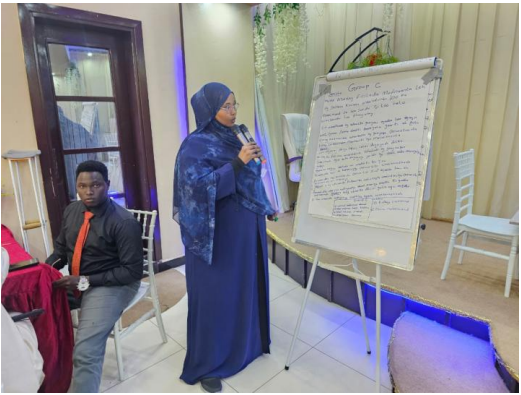
This report provides a comprehensive account of the proceedings and outcomes of the two-day conference on Gender and Inclusive Education held at Matan Café and Bistro Ltd, Mogadishu Somalia. Sponsored by Education for All Somalia (EFASOM) and organized by the Disable Welfare Foundation (DWF), the event brought together a broad spectrum of stakeholders including officials from government ministries, civil society organizations (CSOs), disability rights advocates, educators, media representatives, community leaders and eminent persons from different districts.
The primary goal was to strengthen public and community participation in inclusive education policy programs and to foster mutual accountability between government and CSOs in promoting gender and disability inclusion across Somalia’s education sector. Day 1 focused on knowledge-sharing through keynote addresses, expert presentations, and panel discussions, while Day 2 centered on interactive workshops and collaborative action planning.
2. Objectives
The conference objectives were as follows:
Day 1 (11th August 2025):
- Build a shared understanding of barriers to gender- and disability-inclusive education.
- Align government and CSO roles for improved coordination, accountability, and delivery.
- Share scalable Somali best practices and quick wins.
- Develop a 100-day action plan with clear responsibilities and measurable indicators.
Day 2 (12th August 2025):
- Identify concrete actions for government and CSOs to enhance public participation in inclusive education policies.
- Strengthen monitoring and evaluation (M&E) mechanisms for greater accountability.
- Clarify the roles of communities and the media in promoting gender and disability inclusion.
- Explore sustainable funding and resource mobilization strategies.
3. Key Discussions and Findings
3.1 Somalia’s Inclusive Education Context
- Less than 10% of children with disabilities are in school.
- Literacy rates are 50% for men and 26% for women.
- 4.4 million children and youth (ages 6–18) are out of school, with only 42% of primary school-age children enrolled.
- Girls face early marriage (36% marry before 18), safety issues, and lack of adequate WASH/MHM facilities.
- Children with disabilities encounter stigma, inaccessible infrastructure, and a shortage of trained teachers
3.2 Barriers to Implementation
- Systemic: Fragmented governance, poor coordination between federal and state levels, limited financing, and data gaps in EMIS.
- School-Level: Inadequate inclusive teacher training, lack of assistive devices, inaccessible facilities, and overcrowded classrooms.
- Community-Level: Social norms that favor boys’ education, poverty, and limited parental involvement in school governance.
4. Participating Organizations
The conference brought together a diverse range of stakeholders, including representatives from government bodies, civil society organizations, academic institutions, legal practitioners, and the media. Notable participating organizations included:
Somali Disability Empowerment Network (SODEN), Disable Union Club (DUC), Disable Welfare Foundation (DWF), Regional Human Rights Development Coalition (RHRDC) 5. Office of the Prime Minister (OPM), Somali Association for the Blind (SAB), Wanle Weyn Human Rights and Development Organization (WWHRDO), Rural African Women Development Organization (RAWDO), Education for All Somalia (EFASOM), Khalif Hudow Human Rights Organization (KAHRO), Mogadishu University (MU), Al-Nur School for the Blind, Golaha Barbaarta Araga La’ (GBAL), Benadir Region Council (BRC), Garsame Law Office (GLO), Media Group (MG), Youth Rights Development Organization (YORDO), and Somali National Association of the Deaf (SONAD) among others.
This broad representation ensured that the discussions captured perspectives from across Somalia’s disability rights and inclusion ecosystem, fostering richer dialogue and more inclusive action plans.
5. Strategies and Recommendations
5.1 Strengthening Public Participation
Government Commitments:
- Train and resource Community Education Committees (CECs) with gender/disability quotas.
- Share budgets, plans, and progress in Somali, Braille, and sign language.
- Institutionalize consultation through regional and district forums before policy adoption.
CSO Commitments:
- Produce accessible policy documents in Somali, Braille, audio, and sign language.
- Mobilize marginalized voices, especially women, youth, and persons with disabilities.
- Monitor and report government commitments to the public.
5.2 Monitoring & Evaluation (M&E)
- Integrate disability, gender, and location fields into the national EMIS.
- Develop public dashboards and community noticeboard scorecards.
- Standardize M&E tools nationwide.
- Build capacity of MoECHE, Federal Member States, and CECs on data collection and analysis.
5.3 Role of Media
- Investigate and expose barriers such as inaccessible schools.
- Promote policy dialogue via debates and interviews.
- Showcase role models of girls and learners with disabilities.
- Deliver education content to remote and out-of-school children.
5.4 Funding and Resource Mobilization
- Increase government allocation to meet 15–20% education budget benchmark.
- Engage private sector (telecoms, banks) in inclusive initiatives.
- Establish diaspora contribution channels (school bonds, sponsorship schemes).
- Encourage local fundraising events and savings groups for school support.
6. 100-Day Action Plan
Government:
- Establish inclusive education committees.
- Publish accessible summaries of the Education Sector Strategic Plan (ESSP).
- Allocate emergency funds to address high-priority accessibility gaps.
Civil Society Organizations CSOs:
- Launch community awareness campaigns in at least 10 districts.
- Support CECs in developing inclusion action plans.
Communities & Parents:
- Engage in school governance.
- Participate in safety route mapping and inclusion dialogues.
- Provide feedback through accessible channels.
7. Outcomes
- A shared commitment to improve coordination and data sharing between government and CSOs.
- Agreement on piloting inclusive practices such as Teaching at the Right Level (TaRL) and community-led safety initiatives.
- Strengthened partnerships for advocacy and resource mobilization.
- A clear roadmap for the next 100 days focusing on actionable, measurable, and time-bound goals.
8. Recommendations
Continuous Monitoring and Evaluation of Inclusive Programs: Establish a robust monitoring and evaluation (M&E) framework that integrates gender and disabilitydisaggregated data, with regular progress reviews at district, regional, and national levels. This should include participatory feedback mechanisms to ensure community voices, especially those of women, youth, and persons with disabilities, are incorporated into program adjustments.
Increased Funding for Community-Driven Initiatives: Advocate for increased government budget allocations and explore partnerships with private sector actors, donors, and the Somali diaspora to support grassroots projects. Funding should prioritize locally-led initiatives that address immediate barriers such as accessible school infrastructure, assistive devices, and teacher training in inclusive practices.
Strengthening Advocacy at Local and National Levels: Build the capacity of civil society organizations, community-based groups, and media outlets to engage in policy advocacy. This should include strategic campaigns, policy dialogues, and evidence-based lobbying to influence legislative reforms and secure long-term commitments for inclusive education from decision-makers.
9. Conclusion
The conference successfully created a dynamic platform for dialogue, joint planning, and commitment-building towards advancing inclusive education in Somalia. Over the two days, diverse stakeholders forged stronger relationships, shared practical solutions, and developed actionable strategies to address systemic and community-level barriers. By combining policy reform, community engagement, media advocacy, and resource mobilization, the recommendations outlined in this report offer a realistic and collaborative pathway to achieving equitable access to quality education for all children especially girls and those with disabilities. The momentum generated during this event now provides a solid foundation for sustained partnerships, measurable progress, and lasting impact in the months and years ahead.